
Proper food handling is more than a checkbox—it’s the backbone of safety, quality, and customer trust in every professional kitchen.
This guide explains why it matters, the challenges, how to get certified in Florida, and how to turn certification into a real commercial advantage.
Food handling: the foundation of every professional kitchen
Behind every successful dish—from a humble empanada to a refined dessert—there’s a shared principle: rigorous food handling.
If you’re an entrepreneur in the world of cooking, baking, pastry, ice cream, or any other culinary field, mastering safe food handling isn’t just about complying with the law — it’s about protecting your customers, elevating your brand, and positioning your business as a professional and reliable choice.
Example: A small Miami bakery stores cream fillings above 41 °F (5 °C) for hours. One error leads to foodborne illness, bad reviews, and even temporary closure. The difference between success and failure often lies in how food is handled behind the scenes.
Food hygiene: more than a legal requirement, a competitive advantage
Talking about hygiene is talking about reputation and public health. A clean, well-organized kitchen prevents contamination and builds customer confidence. Today’s consumers seek transparency and responsible preparation.
- Personal hygiene: frequent handwashing, proper uniforms, gloves, masks.
- Temperature control: keep food out of the danger zone (41 °F–140 °F).
- Cross-contamination prevention: separate raw and cooked foods, sanitize surfaces.
- Regular cleaning: sanitize utensils, equipment, and work areas.
- Pest control: prevention, monitoring, and corrective actions.
Example: An Orlando catering company implemented scheduled cleaning every four hours during events, cutting contamination-related waste by 95% and boosting satisfaction. Hygiene became a business advantage, not a cost.
Common challenges in safe food handling
- Lack of training: teams may not fully grasp food safety risks.
- Time pressure: fast-paced services can lead to skipped steps.
- Insufficient equipment: missing thermometers, proper refrigeration, handwashing stations.
- High turnover: constant onboarding without proper training.
- Regulatory complexity: misunderstanding state or local rules can cause fines.
Example: A Tampa food truck failed a health inspection because staff lacked certified training, resulting in a temporary shutdown—avoidable with a short course.
What a food handling certificate is — and what it proves
A food handling certificate (Food Handler Certificate) is an official credential earned after completing an approved course and passing an exam.
It proves knowledge of hygiene, contamination prevention, safe storage, and sanitation protocols. In many cases, it’s a legal requirement to work in or operate a food business.
Example: A family ice cream shop in Fort Lauderdale could only expand into malls after submitting staff certificates—a mandatory step for permits.
Why certification benefits both workers and customers
For workers
- Greater employability and career opportunities.
- Up-to-date technical knowledge and confidence on the job.
- Professional credibility and regulatory compliance.
For customers
- Stronger trust in your brand and processes.
- Lower risk of foodborne illness.
- Clear commitment to public health and safety.
Example: A Jacksonville restaurant announced that 100% of staff were certified; reservations grew 30% in three months due to increased confidence.
Who needs to be certified?



In Florida, most people involved in food service should obtain a food handling certificate, including:
- Chefs, cooks, and kitchen assistants.
- Bakery, pastry, and ice cream shop employees.
- Delivery staff handling prepared foods.
- Catering and event personnel.
- Storage, packaging, and labeling staff.
Example: Even a small family brand selling jams at farmers’ markets needs certified staff if handling perishable ingredients.
Step-by-step: how to get your official license in Florida
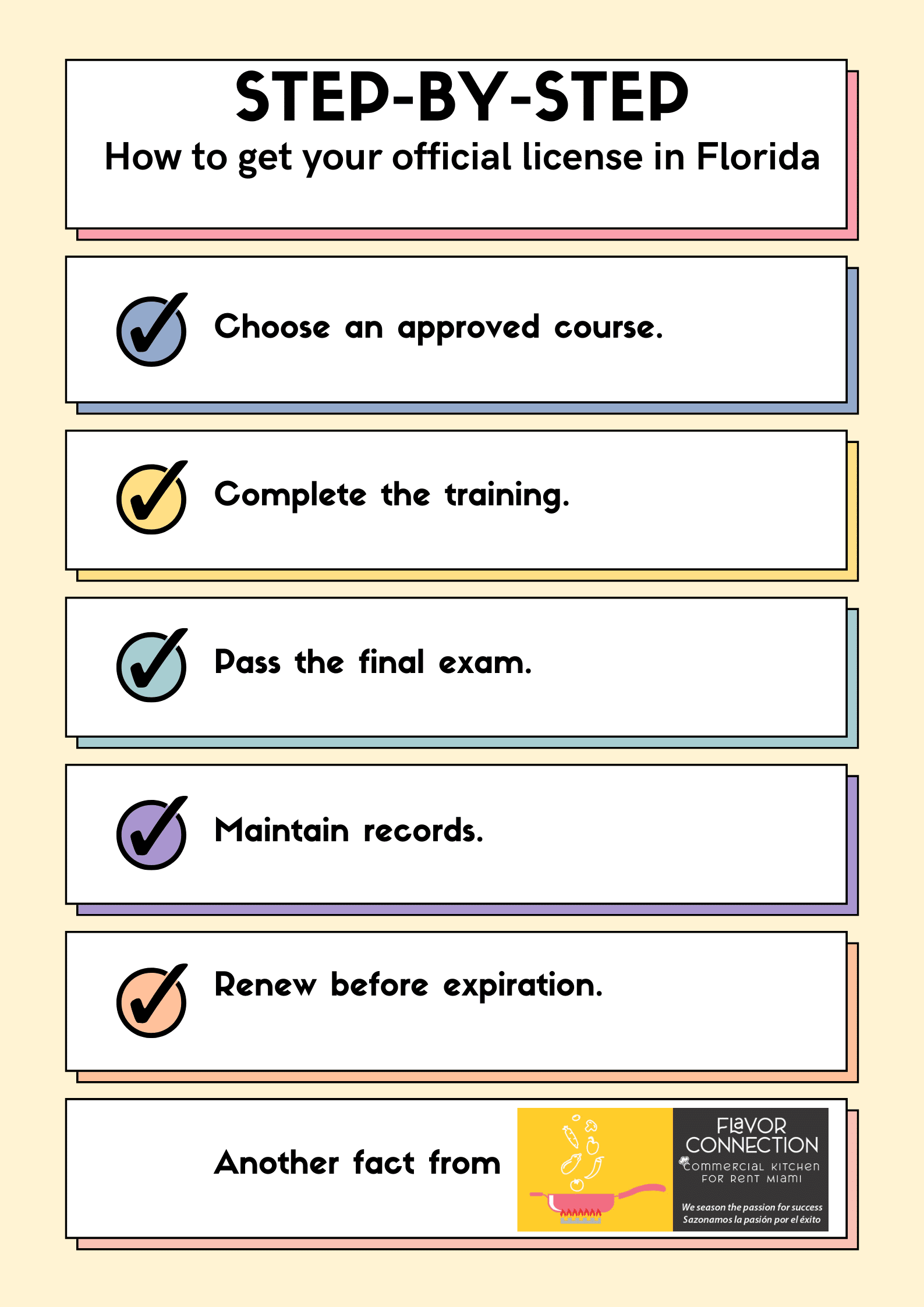
- Choose an approved course.
Select a program approved by the Florida Department of Business and Professional Regulation (DBPR).
Well-known options include StateFoodSafety and ServSafe. - Complete the training.
Most courses take 1–2 hours, fully online, covering hygiene, temperature control, contamination prevention, sanitation, and legal requirements. - Pass the final exam.
Expect a multiple-choice test (often ~40 questions). Minimum passing score is typically around 70%. Certificates are usually available to download/print immediately after passing. - Maintain records.
Some providers report completions directly to DBPR; if not, keep proof of training for audits. - Renew before expiration.
Florida food handler certificates are valid for 3 years; retake the course and exam upon expiry.
Example: A Miami catering company schedules in-house refreshers every two years so the team is recertified well before licenses expire.
Certificate validity, renewal, and maintenance
| Certificate Type | Validity | Renewal |
|---|---|---|
| Food Handler | 3 years | Retake approved course and exam before expiration |
| Food Manager (manager-level certification) | 5 years | Pass an approved recertification exam |
Example: An Orlando restaurant temporarily lost its operating license when the manager-level certification expired. Tracking renewal dates is as critical as obtaining the certificate.
Food safety training: an investment with real returns
- Lower risk of contamination and foodborne outbreaks.
- More efficient operations and reduced waste.
- Better preparation for health inspections.
- Enhanced reputation and customer loyalty.
- Clear differentiation in a competitive market.
Example: An artisanal bakery doubled production and extended shelf life within six months after advanced training improved handling practices.
The commercial power of a certified brand
Certification is a practical safety tool and a marketing asset. Promote your team’s credentials to stand out and increase customer confidence.
- Display certification seals on packaging, menus, and your website.
- Highlight certification in social media and advertising.
- Use it as a selling point with distributors and franchise partners.
Example: A Miami frozen-foods company secured a supermarket contract because its entire staff held valid certifications.
📣 Take the next step with Flavor Connection
Food handling isn’t just a procedure—it’s the foundation of your brand’s reputation, your customers’ safety, and your company’s success in Florida’s culinary market.
At Flavor Connection, we provide guidance and training designed for entrepreneurs and professionals who want to stand out with safety, trust, and credibility.

