
Building a food business in Florida takes more than a marketable recipe. Whether you’re launching a catering company, delivery-only restaurant, food truck, or packaged food brand, your ability to operate depends on securing the right permits and establishing reliable food safety practices.
For many foodservice entrepreneurs, obtaining a Florida DBPR Food License is an essential step. However, licensing requirements differ for businesses manufacturing packaged foods for wholesale distribution.
Understanding that distinction early can prevent expensive mistakes, unnecessary delays, and investments in facilities that cannot legally support your business model.
This guide explains how to identify the appropriate licensing authority, meet food safety requirements, prepare for inspections, and leverage a shared commercial kitchen as your operational foundation.
Which Food License Does Your Florida Business Actually Need?
Understanding DBPR, FDACS, and DOH jurisdiction
Florida regulates food businesses primarily through three agencies: the Department of Business and Professional Regulation (DBPR), the Department of Agriculture and Consumer Services (FDACS), and the Department of Health (DOH).
The appropriate authority depends on what you produce, how you sell it, and where your products are served or distributed.
Business model |
Typical regulator |
Primary activity |
|---|---|---|
| Catering company | DBPR | Preparing food for contracted events |
| Ghost or dark kitchen | DBPR | Preparing meals for delivery |
| Restaurant or takeout business | DBPR | Preparing and serving individual meals |
| Food truck preparing meals | DBPR | Mobile foodservice |
| Wholesale packaged food manufacturer | FDACS | Manufacturing for resale |
| Grocery store or certain retail bakeries | FDACS | Retail food sales |
| Certain institutional foodservice facilities | DOH | Regulated institutional operations |
These categories are general guidelines. Specific products, mixed business activities, and facility arrangements can create exceptions.
Why choosing the right regulator matters
Consider two entrepreneurs operating from commercial kitchen facilities.
One prepares restaurant-style meals for delivery platforms. Their operation would generally fall under DBPR.
The other manufactures packaged cookies for distribution to coffee shops and specialty retailers. That wholesale manufacturing activity would generally fall under FDACS.
Both businesses require regulatory compliance, but their licensing pathways may differ significantly.
Licensing should follow your actual business model, not simply the fact that you prepare food in a commercial kitchen.
How to Apply for a Florida DBPR Food License
Step 1: Establish your business entity
Start by selecting an appropriate ownership structure. Entrepreneurs forming an LLC or corporation generally register through Sunbiz, Florida’s official business registration platform.
Obtain an Employer Identification Number (EIN) from the IRS when applicable, and verify local zoning, tax, and business licensing obligations.
Business registration establishes your legal entity; it does not authorize food production.
Step 2: Identify your foodservice license category
DBPR recognizes different operational classifications, including restaurants with seating, establishments without seating, catering businesses, and mobile food dispensing vehicles.
A delivery-only kitchen preparing individual meals may qualify as a no-seating establishment. A business preparing food for contracted events may fall under the catering classification.
Confirm the appropriate category before submitting your application.
Step 3: Secure an approved production facility
Your application must identify an appropriate location for food preparation, storage, and related activities.
When renting a shared kitchen, verify the facility’s active license and confirm that your intended operation is permitted.
Step 4: Submit the applicable application
DBPR uses Form HR-7035 for certain fixed foodservice licenses, including qualifying operations within existing shared kitchens.
Mobile food businesses follow separate application procedures.
For manufacturing activities regulated by FDACS, applicants must follow that department’s food establishment permitting process instead.
Step 5: Obtain approval before opening
A new operation generally must satisfy its applicable inspection and licensing requirements before beginning commercial foodservice.
Submitting paperwork or completing food safety training does not constitute permission to operate.
ServSafe Manager Certification: What Florida Requires
Does the business owner need certification?
Florida requires certified food protection managers for covered public foodservice establishments.
ServSafe Manager certification in Florida is one recognized option, although other accredited examination programs are also accepted.
Certification does not necessarily have to be held personally by the founder. The business must designate qualified managers and comply with applicable supervision requirements.
When four or more employees are simultaneously involved in food handling, a certified manager generally must be present.
How to become certified
Preparation includes foodborne illness prevention, safe temperatures, personal hygiene, cross-contamination, allergens, and sanitation.
Candidates complete an approved, proctored certification examination. Accepted food manager certifications remain valid for five years.
DBPR generally requires responsible food managers to become certified within 30 days of employment. Food employee training is a separate requirement.
Shared Commercial Kitchens: Infrastructure Without the Upfront Buildout
Why a commissary kitchen can accelerate your launch
Building an independent commercial kitchen requires significant capital for ventilation, plumbing, refrigeration, equipment, and construction.
A shared commercial kitchen offers access to existing infrastructure, allowing entrepreneurs to allocate more capital toward product development, staffing, and customer acquisition.
For qualifying DBPR catering operations sharing an existing DBPR-licensed kitchen, a separate plan review may not be necessary.
However, the shared facility’s license does not replace the entrepreneur’s individual operating license.
What remains your responsibility?
Understanding the requirements for renting a shared kitchen in Florida means separating facility obligations from business obligations.
Requirement |
Facility operator |
Food entrepreneur |
|---|---|---|
| Approved kitchen infrastructure | Provides and maintains | Verifies suitability |
| Business-specific food permit | Does not automatically provide | Obtains when required |
| Food manager certification | Covers its own personnel | Covers designated managers |
| Food handling procedures | Maintains shared systems | Manages its operations |
| Insurance and agreements | Defines contractual terms | Meets applicable conditions |
A written rental agreement should address kitchen access, equipment, storage, sanitation responsibilities, and insurance.
DBPR’s HR-7022 commissary notification is relevant to certain mobile arrangements; it is not universally required for every shared kitchen operator.
A licensed kitchen can lower the barriers to entry. It cannot transfer its regulatory responsibilities or operating authorization to an independent business.
How to Prepare for DBPR Health Inspections
What inspectors evaluate
DBPR health inspections assess actual operating practices, including temperature controls, food storage, employee hygiene, sanitation, and contamination prevention.
Foods requiring time and temperature control generally must be maintained at 41°F or below for cold holding and 135°F or above for hot holding, subject to applicable exceptions.
Inspectors may also review handwashing facilities, employee training documentation, cleaning procedures, and food protection practices.
Your pre-inspection checklist
If you’re researching how to pass a food inspection in Florida, review your operation before the scheduled inspection:
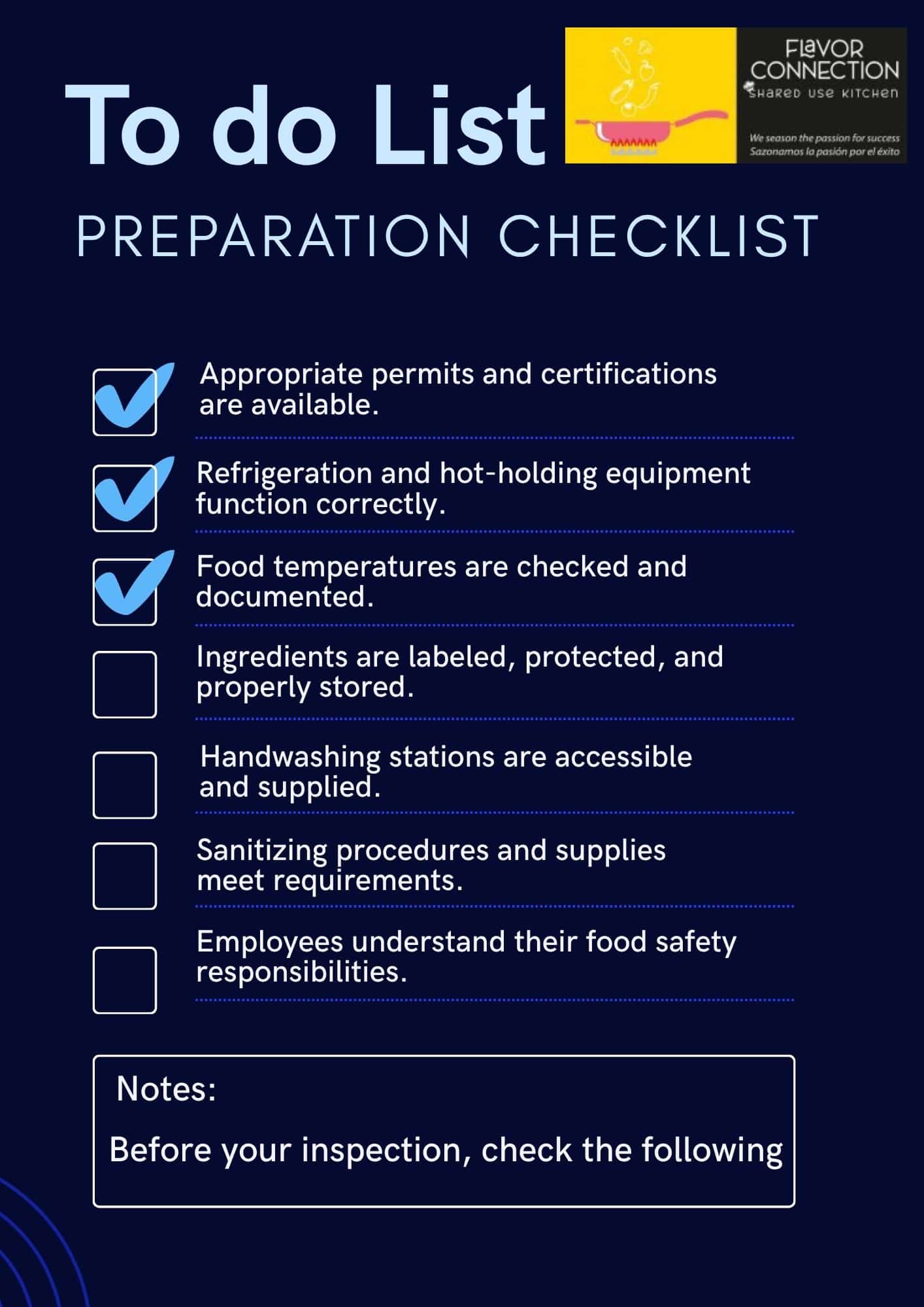
Passing an opening inspection confirms compliance at that point in time. Long-term operational resilience depends on maintaining those standards every day.
Budgeting for Food Business Compliance
Licensing is only one component of startup expenditure.
Your financial model should also account for certification, insurance, kitchen rental, storage, inspections, and potential facility modifications.
Cost category |
Budget consideration |
|---|---|
| Licenses and permits | Depends on jurisdiction and operation |
| Food safety certification | Training and examination expenses |
| Shared kitchen rental | Production hours and storage |
| Commercial insurance | Coverage requirements and business risks |
| Equipment or modifications | Product-specific operational needs |
Shared infrastructure can reduce initial capital expenditure, but frequent rental hours and storage requirements may increase operating costs as production grows.
Evaluate your expected contribution margin, production capacity, and break-even volume before committing to long-term facility expenses.
Frequently Asked Questions About Florida Food Licensing
Will I lose my DBPR license if I change shared kitchens?
Not automatically, but location changes may require a new application, license, or inspection. Confirm the applicable procedure with DBPR before relocating.
Can I start selling immediately after passing ServSafe?
No. Certification does not replace required operating licenses, permits, or inspections. Obtain all necessary approvals before selling food.
Can I legally prepare food for sale at home in Florida?
Florida’s Cottage Food Law allows certain low-risk products sold directly to consumers, subject to restrictions. Wholesale distribution is not permitted.
Is ServSafe Food Handler equivalent to ServSafe Manager?
No. Food Handler addresses employee food safety practices. Manager certification demonstrates supervisory food protection knowledge and fulfills different regulatory requirements.
Compliance Is the Foundation of Scalable Food Businesses
Licensing, inspections, and food safety systems are business assets. They support operational continuity, reduce exposure to preventable risks, and help entrepreneurs establish credibility with commercial buyers.
Securing the right infrastructure is equally important. A professionally equipped shared kitchen allows emerging food brands to build production capacity without immediately investing in a standalone facility.
Flavor Connection provides professional shared kitchen infrastructure designed to support food entrepreneurs as they develop products, strengthen operations, and prepare for commercial growth.
Ready to launch or expand your food business in Florida? Explore Flavor Connection and discover how professional kitchen facilities can support your operations while you secure the licenses and permits required for your business.

