
Likes do not pay kitchen rent, prep labor, packaging, or the produce invoice that keeps rising before the weekend rush.
Many food brands launch with strong visuals: dripping cheese, glossy sauces, sharp packaging, cinematic Reels. Then the operating reality appears: empty DMs, users asking for price and disappearing, high bounce rates, confusing menus, and a checkout flow that kills the sale before the kitchen gets the ticket.
A gastronomic conversion funnel is not a marketing accessory. It is the bridge between organic reach and revenue. For dark kitchens, virtual restaurant concepts, QSR startups, and delivery-first brands, that bridge determines whether Instagram is a showroom or a sales channel.
What is a gastronomic conversion funnel?
A gastronomic conversion funnel is the system that moves a hungry consumer from first visual craving to paid order. In food business, attention is only the opening move. The real work is reducing the distance between appetite, trust, decision, and transaction.
For QSR and dark kitchen operations, the funnel has three layers: TOFU, MOFU, and BOFU. TOFU creates desire. MOFU removes doubt. BOFU removes friction.
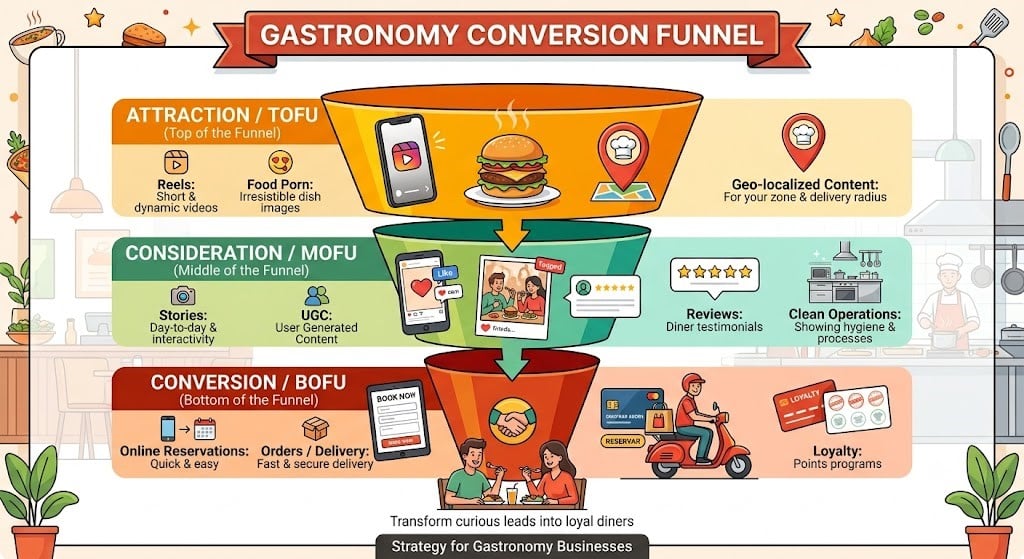
Direct order link, clear menu, fast checkout
A gastronomic conversion funnel for delivery brands only works when every asset has a financial role. A Reel is not successful because it looks appetizing; it is successful when it moves users toward orders, repeat purchase, and customer retention.
Phase 1: Attraction: The visual craving in the feed
Craveable content and Reels
Food is visual, but algorithms do not buy dinner. Content must grab attention and filter intent. A 7-to-12-second Reel showing texture, steam, crunch, sauce pull, portion size, and packaging can generate reach, but the key metric is how many viewers move to the profile or order link.
This is where restaurant marketing funnel conversion becomes a creative discipline. Camera angle, prep sequence, close-up timing, and overlay text must answer three questions fast: what is it, why do I want it, and how do I order it?
The weak version of food content is aesthetic but operationally empty. If the video does not clarify service area, schedule, signature product, or CTA, it attracts spectators instead of buyers.
Bio optimization: Your digital storefront
The bio is the brand’s digital host. In less than five seconds, it must tell users whether they can order, where delivery is available, when food is dispatched, and why this brand deserves the order.
A high-converting bio should include:
- Delivery area by city, ZIP code, or service radius.
- Real dispatch hours, not aspirational availability.
- Clear value proposition: “craft smash burgers,” “healthy Latin meal prep,” “premium late-night tacos.”
- One direct link to ordering, menu, or platform.
- Trust signal: rating, certified kitchen, order volume, press mention.
- Direct CTA: “Order now,” “Pre-order for tonight,” “Book catering.”
Funnel metric |
Surface reading |
Real financial impact |
| Reel views | Reach and visibility | Low value if profile clicks do not follow |
| Profile clicks | Initial intent | Early commercial signal |
| Link clicks | Active demand | First indicator of viable CAC |
| Saves | Deferred desire | Future order or repeat-purchase potential |
| Story replies | Trust and interaction | Closing opportunity without discounting |
Phase 2: Consideration: Building trust through Stories
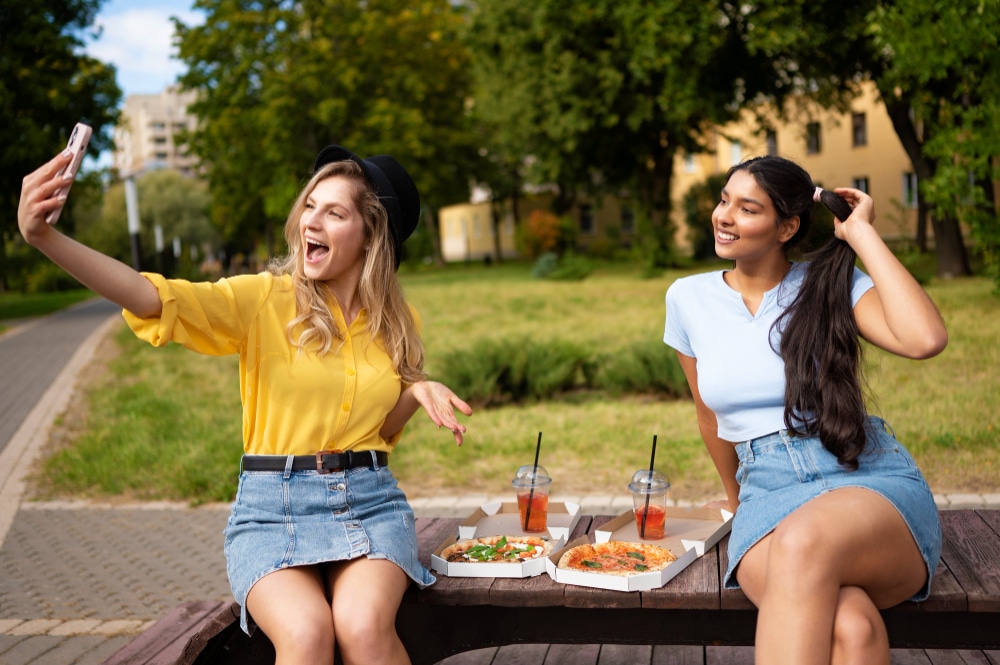
Daily Stories and interaction
Food decisions happen with hunger, little time, and low tolerance for uncertainty. Stories operate inside that psychological window. They show freshness, availability, preparation rhythm, and human presence.
Polls, question stickers, countdowns, and craving sliders are not decorative. They are micro demand signals. If 80 users vote for brisket tacos before lunch, the kitchen can adjust mise en place, reduce waste, and protect variable costs.
There is also a safety signal. Showing clean stations, sealed packaging, disciplined prep, and temperature-aware handling communicates food safety. The FDA describes the Food Code as a model for safe food handling practices in retail and foodservice settings, while state, local, tribal, and federal regulators use it to develop or update their own food safety rules.
Social proof: UGC and digital word of mouth
UGC (User Generated Content ) turns uncertainty into evidence. A customer opening the package, showing temperature, praising portion size, or tagging the brand after a small event carries more weight than a polished brand post.
The reason is practical: consumers do not only buy flavor. They buy expected execution. Will it arrive hot? Does the portion match the image? Does the packaging survive delivery? Is the menu clear?
Inside the gastronomic conversion funnel, social proof reduces perceived risk. That improves conversion without discounting, which protects gross margin.
Phase 3: Conversion: Removing order friction
 The perfect ordering link
“DM for price” is a financial leak. It forces manual response, delays decision-making, and turns an impulse purchase into a conversation competing with hunger, work, traffic, and every other food option nearby.
A gastronomic conversion funnel for delivery brands should move the user into an interactive menu with real photos, clear modifiers, current availability, integrated payments, and estimated delivery or pickup time.
WhatsApp can work for catering, corporate orders, or service recovery, but it should not become the bottleneck of a lunch rush. Automation does not remove hospitality; it prevents lost orders caused by slow response time.
Order friction |
User effect |
Cart abandonment risk |
| “Ask price by DM” | Delays decision | High |
| Heavy PDF menu | Poor mobile navigation | Medium-high |
| Too many link options | Choice paralysis | Medium |
| No Apple Pay/Google Pay | More payment steps | Medium-high |
| Interactive menu with clear CTA | Fast decision | Low |
The power of clear CTAs
A food CTA should not ask for engagement. It should ask for action. “Order now before 2 PM,” “Get the lunch combo,” “Pre-order Friday dinner,” or “Tap to build your bowl” moves the customer toward transaction.
This is where restaurant marketing funnel conversion changes the scorecard. The best post is not the one with the most likes; it is the one that generates orders, average ticket growth, repeat purchase, and scalability.
The delivery engine: Kitchen efficiency
Infrastructure ready for success
Marketing without operational capacity is a dangerous promise. If the campaign works and the kitchen collapses, growth becomes delay, refunds, poor reviews, and trust erosion.
A traditional kitchen often carries high fixed rent, heavy buildout costs, fragmented permits, maintenance responsibility, and underused labor outside peak periods. A professional shared kitchen or ghost kitchen can improve elasticity by connecting production space, sanitation standards, equipped stations, and costs that better match volume.
From a unit economics perspective, the gastronomic conversion funnel only scales when operations can absorb demand without breaking margin. CAC CAC (Customer Acquisition Cost) may fall, but if average ticket does not cover food cost, packaging, commissions, labor, and delivery fees, growth accelerates losses.
Operating variable |
Traditional kitchen |
Professional shared kitchen |
| Initial investment | High: buildout, equipment, rent deposits | Lower: infrastructure already in place |
| Fixed costs | Elevated and rigid | More controlled by stage |
| Activation timeline | Months | Weeks, depending on local permits |
| Scalability | Limited by owned space | More flexible by shifts/stations |
| Financial risk | High before demand validation | Lower for concept testing |
| Operational support | Internal team dependent | May include shared services |
Regulation also requires precision. The FDA states that more than 3,000 state, local, and tribal agencies have primary responsibility for regulating retail food and foodservice industries in the United States, including restaurants and grocery stores. A delivery brand must validate requirements in the jurisdiction where it operates.
Federal menu labeling rules also matter as brands scale. FDA menu labeling requirements apply to restaurants and similar retail food establishments that are part of a chain with 20 or more locations, operate under the same name, and offer substantially the same menu items.
FAQ
What FDA regulations affect a delivery brand operating from shared kitchens?
The FDA Food Code provides a model for retail food safety, but enforcement is generally handled by state and local authorities. Menu labeling may apply once a brand reaches 20 or more locations under the same name with substantially similar menu items.
How does funnel conversion rate affect Customer Acquisition Cost (CAC)?
When more visitors complete orders, effective CAC decreases because the same content or ad spend produces more revenue. Weak conversion forces the brand to buy more traffic for the same order volume, reducing margin and cash efficiency.
What minimum local permits are usually required to activate a delivery menu in the USA?
Common requirements include a business license, local health permit, food establishment inspection, sales tax permit, and documentation for the approved kitchen facility. Requirements vary by city, county, and state, so local verification is mandatory before selling.
What percentage of sales should be reinvested into the digital funnel for scalable growth?
Independent food brands often evaluate 5% to 12% of sales for marketing, adjusted by gross margin, CAC, average ticket, and repeat purchase rate. If operating margin is weak, more marketing spend can simply scale losses faster.
Growth is not more demand; it is better demand architecture
The next delivery winner will not be the brand with the most filters. It will be the one that converts attention into profitable orders and profitable orders into repeatable capacity.
A gastronomic conversion funnel is a growth discipline, but it is also an operational maturity test. It demands content that creates appetite, technology that removes friction, data that protects margin, and infrastructure that handles volume without damaging the guest experience.
Flavor Connection was built for that inflection point: where culinary ambition needs structure, compliance, professional kitchen infrastructure, and financial discipline. For founders who understand that scaling is not improvising faster, but building on a platform designed to perform.
Schedule a facility tour or request a strategic consultation. Your next stage does not need more digital noise; it needs an operation built to convert.

