
A kitchen can post strong weekly sales and still lose money every day. The problem is not always weak demand. More often, margin disappears through invisible operational failures: poorly organized stations, impulse purchasing, wasted motion, duplicated tasks, stockouts during peak hours, remake rates nobody tracks, and decisions made under pressure. Those leaks rarely appear in marketing reports, yet they shape profitability, team stability, and expansion potential.
Mise en place solves that problem at the source. What many operators still treat as simple prep work must be understood as operating architecture. When a business masters Mise en place, it does not just cook more efficiently. It improves labor deployment, protects food cost, shortens ticket times, stabilizes quality, and creates a system that can scale without relying on constant firefighting.
The principle popularized by Auguste Escoffier was about organized readiness before service. In a modern hospitality environment, that principle evolves into something broader: demand planning, standardized execution, real-time replenishment, and measurable control over kitchen output. That is why Mise en place is no longer exclusive to fine dining. It is a strategic requirement for shared kitchens, delivery-first brands, premium cafés, high-volume catering operations, and any food business that wants to grow like an asset rather than function like a daily emergency.
What Mise en Place Really Means
Often translated as “putting in place,” Mise en place is commonly reduced to chopping vegetables, portioning proteins, preparing sauces, or setting tools before service begins. That definition is too narrow for founders, operators, and investors.
From a strategic perspective, Mise en place is a system designed to eliminate friction before friction becomes cost. It aligns ingredients, labor, equipment, timing, storage, sequence, and communication so the kitchen can perform under pressure with less waste and more consistency. It is not just about readiness. It is about predictability.
When that structure is missing, the symptoms look familiar: inconsistent portions, excessive movement, ticket delays, overproduction, rushed purchasing, confused handoffs, poor training outcomes, and a team that works hard without creating enough margin. In those conditions, operational effort rises while enterprise value stalls.
The difference between a reactive kitchen and a profitable kitchen is rarely menu creativity. It is the quality of the system behind execution.
Static Mise en Place and Dynamic Mise en Place
One of the most common mistakes is assuming Mise en place ends before the first ticket prints. In reality, it has two connected dimensions, and profitable kitchens manage both with discipline.
Static Mise en Place
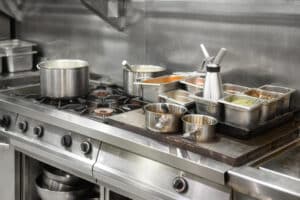

Static Mise en place includes everything prepared before service: base production, labeling, opening stock, equipment checks, portioning, station setup, prep prioritization, and production targets for the shift. Its role is to reduce uncertainty. It gives the team a starting advantage by making resources visible, accessible, and ready for use.
Dynamic Mise en Place
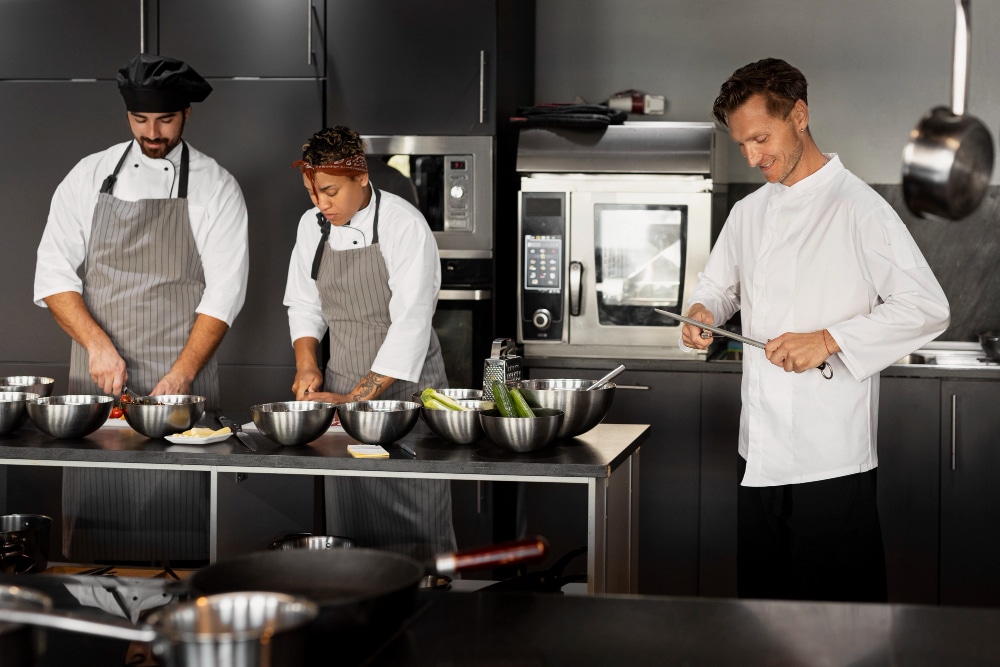
Dynamic Mise en place takes place during service. It includes intelligent replenishment, task reassignment, communication between stations, bottleneck management, order prioritization, and live adjustment based on the actual pace of demand. Its role is to protect throughput once the pressure rises.
The first prepares capacity. The second converts that capacity into sustainable revenue. A kitchen that only masters static Mise en place can open cleanly and still collapse at peak hour. A kitchen that masters both turns pressure into controlled output.
Financial Impact Matrix
| KPI | Systemized Mise en place | Reactive Operation |
|---|---|---|
| Waste | Low and controllable | High and unstable |
| Labor Cost | Optimized | Inflated |
| Ticket Time | Predictable | Irregular |
| Overtime | Occasional | Frequent |
| Staff Turnover | Lower burnout | Higher fatigue |
| Guest Experience | Consistent | Unstable |
Order is not cosmetic. It is financial leverage. Every improvement in these indicators strengthens margin, increases review consistency, reduces internal stress, and improves the business’s ability to scale without margin erosion.
The Hidden Cost of Improvisation
Improvisation is often romanticized in hospitality. In reality, it is one of the most expensive operating models a kitchen can adopt. Every time a cook leaves the line to find ingredients, every time prep runs short during a rush, every time a station waits on another station, and every time an item must be remade, the business pays.
That cost shows up in overtime, guest dissatisfaction, stressed labor, avoidable waste, lower throughput, and lost repeat business. The danger is that these losses rarely sit in one clearly labeled line on a profit-and-loss statement. They are spread across labor, food cost, service inconsistency, and management fatigue. That is exactly why so many operators underestimate the true economic value of Mise en place.
Improvisation may feel flexible in the short term, but over time it destroys predictability, weakens unit economics, and makes scale harder, not easier.
Kitchen Workflow Optimization
Profitability depends on systems as much as talent. Kitchen workflow optimization examines motion, waiting time, congestion points, and handoff failures to redesign the operation around productive output.
- How many steps does a cook take to complete one dish?
- Which station creates the most delay?
- Where do tickets accumulate during the rush?
- Which product always runs out at peak demand?
- Which task consumes time without adding value?
The answers influence layout, storage logic, production sequence, restocking rules, and team responsibilities. A kitchen does not need a larger footprint to become more efficient. It often needs less friction per order.
When Mise en place is integrated into workflow design, the kitchen stops operating on instinct and starts operating with business logic. That transition matters because optimized flow is not only about speed. It is about protecting labor productivity and converting limited square footage into higher output.
Labor Cost Reduction Without Sacrificing Talent
Labor cost reduction should never be confused with indiscriminate headcount cuts. The goal is not to force fewer people to do more in a broken system. The goal is to generate more value from every paid hour.
Strong Mise en place reduces the time teams spend searching for tools, waiting on instructions, redoing prep, or reacting to preventable problems. Recovered time becomes usable production time. That improves speed, consistency, upselling opportunities, guest satisfaction, and the overall quality of the work environment.
A disciplined kitchen often discovers that the same payroll can produce significantly more output when the system is clear. That is one of the most overlooked benefits of Mise en place: it protects both margin and morale.
Food Cost Control at the Source
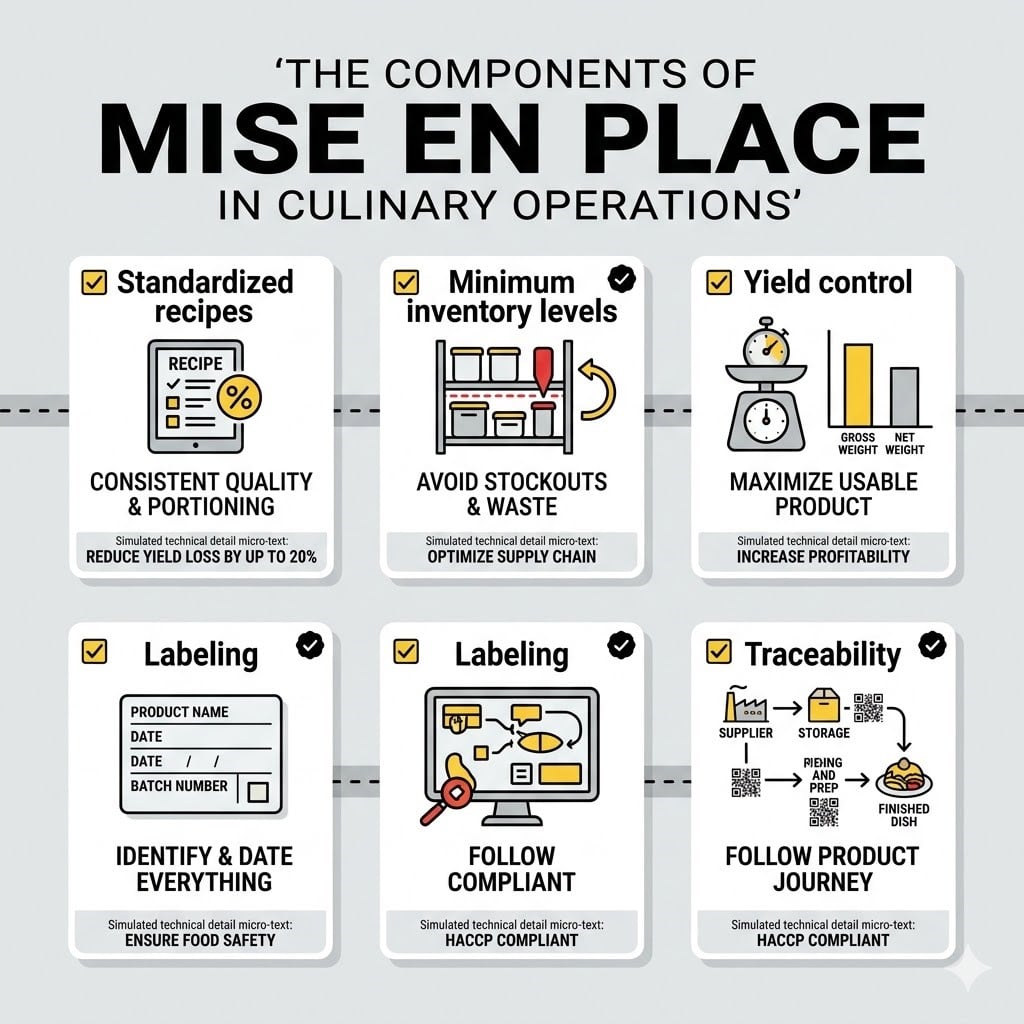
Food cost control is not just a purchasing issue. Supplier pricing matters, but many food businesses lose margin because of inconsistent portions, weak forecasting, overproduction, poor stock rotation, and untracked losses.
Mise en place addresses those problems by linking standardized recipes, yield expectations, minimum stock levels, labeling discipline, prep batching, and traceability. Every ingredient enters a controlled usage path instead of drifting through a chaotic cycle of overuse and spoilage.
Negotiating better with suppliers matters. Executing better inside the kitchen matters more. If operational discipline is weak, better purchasing only slows the leak; it does not stop it.
Standardization as Brand Protection
For founders and multi-unit operators, consistency is not only an operational goal. It is brand protection. A guest does not experience a business through its internal effort. The guest experiences speed, flavor, accuracy, presentation, and reliability.
Mise en place supports that consistency by creating repeatable conditions. It protects the business from the variability of different shifts, different team members, and different daily pressures. Without it, quality becomes personality-driven. With it, quality becomes system-supported.
That distinction is critical. A brand cannot scale if its standards live only in the memory of a few experienced employees. Scalable brands encode standards into process, training, and station logic. That is exactly where Mise en place becomes an enterprise tool, not just a culinary habit.
How to Measure Operational Maturity
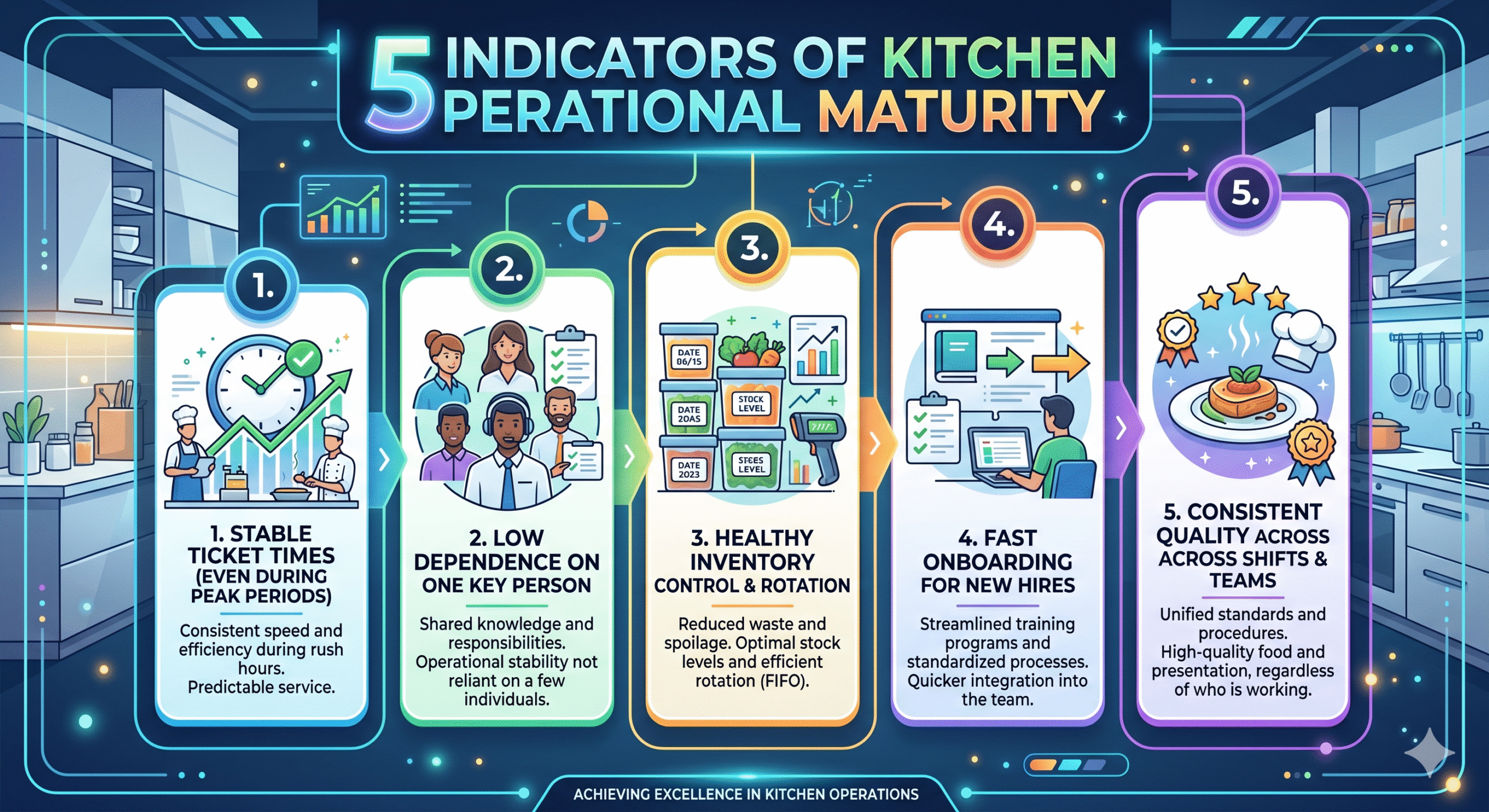
A mature operation is not the one working hardest. It is the one producing repeatable results with lower friction. Five signals reveal that maturity:
- Stable ticket times even during peak periods.
- Low dependence on one key person.
- Healthy inventory control and rotation.
- Fast onboarding for new hires.
- Consistent quality across shifts and teams.
When these variables fail, the business usually has a system problem, not just a people problem. Strengthening Mise en place improves how quickly the kitchen can train, recover, adapt, and maintain standards under pressure.
Mise en Place by Business Model
| Model | Operational Priority | Mise en place Focus |
|---|---|---|
| Ghost Kitchen | Speed and volume | Batch production, rapid assembly, delivery integration |
| Fine Dining | Precision and experience | Course timing, detail control, sensory consistency |
| High-Volume Catering | Scale and logistics | Bulk production, safe holding, coordinated dispatch |
| Premium Café | Continuous flow | Short replenishment cycles, visibility, peak speed |
| Multi-Brand Hub | Operational complexity | Shared prep, unified standards, centralized control |
Mise en place should never be copied blindly between models. A delivery-first brand has different throughput pressures than a tasting-menu restaurant. A catering company manages logistics and holding risk differently than a café handling repeated micro-peaks. The system must serve the business model’s economics, not culinary nostalgia.
Technology Benchmark
| Tool | Main Advantage | Limitation |
|---|---|---|
| Manual (paper/whiteboard) | Low cost and fast setup | No traceability or analytics |
| Kitchen ERP | Costing, recipes, purchasing, inventory | Higher implementation curve |
| Cloud Management | Real-time data, multi-site visibility, mobility | Requires operational discipline |
Technology does not replace culinary judgment. It multiplies it. The best operators use digital tools to make Mise en place more visible, measurable, and easier to manage across teams and locations. Forecasting, inventory control, prep planning, and labor visibility become stronger when supported by systems that reduce guesswork.
That matters even more in shared-kitchen and multi-unit environments, where complexity compounds quickly. A process that feels manageable in one location can become expensive chaos across three or five units if it is not digitally supported.
Forecasting, Planning, and Expansion Readiness
Growth exposes weak systems. A kitchen can survive poor structure at low volume because the founder compensates manually. That approach collapses when order volume increases, product mix expands, or new units open.
Mise en place improves expansion readiness because it forces the business to think in forecasts, prep ratios, labor sequencing, and repeatable station standards. It turns production from something reactive into something planned.
That planning discipline is what allows operators to increase output without multiplying confusion. The more scalable the brand ambition, the more essential Mise en place becomes as the operating language of the business.
Flavor Connection: From Operator to Asset Owner
Many founders know how to cook but remain trapped in operational self-employment. If the business depends entirely on their physical presence, they do not own a scalable asset. They own a demanding job.
Flavor Connection changes that equation through shared kitchens designed to professionalize systems, reduce fixed-cost pressure, and support repeatable structures. It gives culinary entrepreneurs an environment where disciplined Mise en place can translate into stronger output, lower operational drag, and more scalable unit economics.
Real growth does not happen by adding more menu items. It happens when the business can sell, operate, train, and expand without relying on daily heroics from the founder.
Operational Scalability and Enterprise Value
Operational scalability appears when more demand creates better financial results instead of more chaos. If doubling orders doubles stress, mistakes, and waste, there is no scale. There is only bigger disorder.
If doubling orders improves fixed-cost absorption because processes are strong, standards are clear, and Mise en place is consistent, then enterprise value rises. That is the point where a kitchen stops being merely operational and becomes strategically investable.
Investors do not pay premium multiples for hustle alone. They pay for repeatability, margin protection, and confidence that growth will not break the system. In hospitality, strong Mise en place is one of the clearest indicators that a business understands the economics of scale.
Frequently Asked Questions
What is Mise en Place in a professional kitchen?
Mise en place is an operating system that organizes ingredients, tools, timing, labor, and inventory before and during service to improve speed, consistency, cost control, and execution quality.
How does Mise en Place reduce costs?
It lowers waste, mistakes, overtime, urgent purchasing, and idle time. It also improves labor productivity and service speed, which strengthens operating margin without depending only on price increases.
What is the difference between static and dynamic Mise en Place?
Static Mise en place happens before service through preparation and setup. Dynamic Mise en place happens during service through replenishment, task adjustments, and real-time prioritization.
Is Mise en Place useful for ghost kitchens?
Yes. In delivery-first models, speed, order accuracy, and consistency drive retention and reviews. Strong Mise en place allows higher volume with less friction and fewer fulfillment failures.
What technology improves Mise en Place?
Inventory systems, costing tools, planning platforms, dashboards, and cloud-based management tools improve visibility, standardization, and real-time decision-making across teams and locations.
The Line Between Survival and Market Leadership
Reactive kitchens compete through endurance. Systemized kitchens compete for market share. That difference will define which brands attract talent, open new units, preserve margin, and build long-term value in the next stage of hospitality.
Mastering Mise en place is no longer a secondary kitchen skill. It is strategic leverage. Flavor Connection turns that leverage into real, measurable, and scalable growth for operators who want to move from daily execution to durable enterprise value.

