This strategic report, developed by Flavor Connection, provides an executive analysis of the culinary trends expected to shape the U.S. Food & Beverage industry throughout H2 2026. Beyond identifying trending ingredients, it examines how Emerging Flavors are influencing product innovation, menu engineering, unit economics, and operational scalability for restaurant operators, ghost kitchens, virtual brands, and growth-stage food businesses seeking sustainable expansion.
For restaurant founders, ghost kitchen operators, virtual brands and food entrepreneurs scaling across the U.S., understanding Emerging Flavors is no longer a marketing exercise—it’s a competitive advantage. Flavor innovation now influences menu engineering, customer retention, operational efficiency and long-term profitability.
At Flavor Connection, we see culinary innovation through a different lens. Great flavors matter, but scalable businesses are built when product development, culinary R&D and operational systems evolve together. The brands that outperform the market will connect memorable taste experiences with disciplined execution.
The Sensory Palette of the Second Half
Seasonal food trends have traditionally followed a predictable cycle. Summer celebrates freshness, tropical fruit and vibrant acidity, while fall and winter introduce warmth, roasted notes and nostalgic comfort foods.
H2 2026 breaks that pattern.
Consumers are increasingly seeking layered sensory experiences that combine familiarity with discovery. Instead of choosing between sweet or smoky, spicy or savory, they now expect multiple flavor dimensions within a single bite.
This evolution is fueling demand for Emerging Flavors built around concepts like Swokey (Sweet + Smoky), Swangy (Sweet + Tangy), controlled fermentation, botanical citrus, toasted aromatics and premium umami.
The opportunity for food businesses extends far beyond trend adoption.
Successful operators will transform these flavor movements into repeatable culinary systems that improve unit economics, strengthen brand positioning and simplify production across multiple menu categories.
Flavor Connection Insight
Tomorrow’s leading food brands won’t succeed because they launch the most products. They’ll succeed because they build scalable flavor platforms capable of evolving without increasing operational complexity.
Flavor Evolution: The Emerging Flavors Defining H2 2026
During the first half of the year, Swicy (Sweet + Spicy) combinations dominated innovation across beverages, snacks and fast-casual menus.
As consumer preferences mature throughout H2, demand shifts toward deeper, more sophisticated flavor compositions.
Smoke replaces heat as the primary source of contrast.
Fermentation replaces excessive sweetness.
Botanical complexity begins replacing conventional citrus.
Among the most influential Emerging Flavors expected to shape late 2026 are:
- Swokey flavor systems combining caramelized sweetness with natural smoke.
- Deep umami developed through koji, premium miso and controlled fermentation.
- Botanical citrus paired with rosemary, sage and floral herbs.
- Warm spices reinterpreted through modern extraction and infusion techniques.
These trends are also redefining Innovative Pairings.
Rather than relying on one dominant flavor note, chefs and food developers are designing layered taste journeys that unfold throughout the eating experience.
Examples include:
- Charred peach, smoked chili and rosemary.
- Mandarin, infused olive oil and pink peppercorn.
- White miso, brown butter and roasted fig.
- Pear, fermented honey and sage.
Each pairing increases perceived menu value while maintaining manageable variable costs, provided flavor systems are designed strategically during product development.
This approach offers particular advantages for ghost kitchens and virtual restaurant concepts.
Instead of developing unique sauces for every SKU, operators can create versatile flavor platforms supporting multiple categories:
- premium burgers;
- grain bowls;
- artisan pizzas;
- roasted vegetables;
- sandwiches;
- protein glazes;
- seasonal desserts.
The result is stronger menu identity with lower operational complexity.
From a financial perspective, this strategy improves inventory utilization, simplifies purchasing and creates healthier unit economics through ingredient standardization.
Strategic Perspective
Culinary innovation is no longer measured by how many new ingredients appear on a menu. It’s measured by how effectively one flavor platform can power multiple revenue streams.
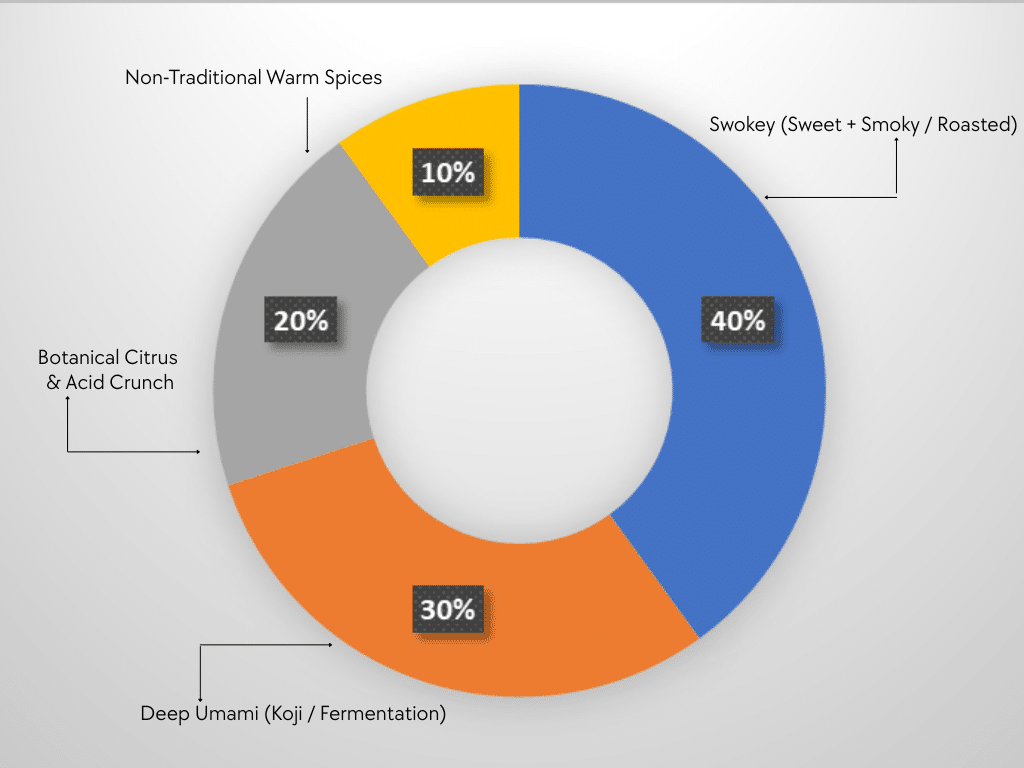
📊 Figure 1. Projected Distribution of Emerging Flavor Profiles (H2 2026)
Strategic Interpretation
The projected growth of Swokey profiles is driven by three operational advantages:
- broad compatibility across proteins, vegetables and desserts;
- strong seasonal storytelling opportunities;
- excellent delivery performance, as roasted and smoked aromatics maintain flavor integrity during transportation.
Meanwhile, fermentation-driven umami continues to define many of the new flavors 2026, especially among premium fast-casual brands seeking to deliver a sensory culinary experience without dramatically increasing production complexity.
Ingredient Matrix: Building Emerging Flavors for H2 Menus
The most profitable culinary innovations rarely begin with a recipe—they begin with a scalable ingredient strategy.
High-performing restaurant groups, ghost kitchens and consumer packaged food brands develop flavor systems that can be deployed across multiple menu categories rather than creating isolated recipes for individual products.
For operators preparing for H2 2026, every ingredient should be evaluated through three business lenses:
- differentiation potential;
- production efficiency;
- contribution to unit economics.
When a single ingredient supports multiple menu applications, inventory becomes more efficient, purchasing becomes simpler and food waste decreases.
At Flavor Connection, we encourage founders to think in terms of flavor platforms instead of individual menu items.
One signature sauce, infused oil or fermented glaze should become the foundation for proteins, sandwiches, grain bowls, appetizers, desserts and seasonal limited-time offers.
Flavor Connection Insight
Every ingredient added to your inventory should justify its operational footprint. If it serves only one menu item, it’s likely reducing scalability rather than creating value.
📋 Table 1. Emerging Ingredients vs. Menu Applications (H2 2026)
Emerging Ingredient |
Flavor Profile |
Recommended Applications |
Business Value |
|---|---|---|---|
| Koji | Deep Umami | Marinades, glazes, compound butters | High |
| Premium Chili Crunch | Heat + Texture | Bowls, burgers, pizzas, noodles | Very High |
| Citrus Herb Infused Oil | Botanical Freshness | Pasta, vegetables, proteins, salads | High |
| White Miso | Sweet Umami | Dressings, sauces, desserts | High |
| Swokey Glaze | Sweet + Smoky | Chicken, ribs, vegetables, burgers | Very High |
| Botanical Finishing Salt | Aromatic Finish | Fries, snacks, vegetables, proteins | High |
| Fermented Honey | Layered Sweetness | Bakery, beverages, brunch | Medium-High |
| Brown Butter | Toasted Nutty Notes | Pastry, vegetables, premium proteins | High |
These ingredients support Innovative Pairings while minimizing unnecessary operational complexity.
Consider a single Swokey glaze developed during batch production.
Instead of serving one signature item, it can become the flavor foundation for:
- premium wings;
- grilled chicken;
- roasted vegetables;
- artisan pizzas;
- gourmet burgers;
- sandwiches;
- seasonal appetizers.
From an operational standpoint, this approach strengthens product consistency while supporting food safety, standardized execution and simplified staff training.
From Trend Adoption to Operating System
Many food businesses confuse culinary creativity with sustainable innovation.
Adding trendy ingredients without a broader operational strategy often leads to larger inventories, inconsistent execution and unnecessary purchasing costs.
Scalable brands approach innovation differently.
Rather than launching isolated recipes, they build repeatable systems capable of generating multiple revenue opportunities from the same culinary assets.
The operational advantages include:
- Faster production times.
- Improved inventory turnover.
- Reduced dependency on highly specialized labor.
- Easier replication across multiple locations.
For virtual restaurant brands operating inside shared commercial kitchens, these efficiencies become even more valuable.
Every minute removed from assembly time increases production capacity without requiring additional kitchen space or equipment.
Growth Perspective
Consumers remember extraordinary flavors. Investors remember repeatable operating systems. Sustainable food brands are built by mastering both.
Why Emerging Flavors Also Improve Unit Economics
A common misconception within food entrepreneurship is that sophisticated menus automatically increase operating costs.
In reality, properly engineered flavor systems frequently reduce labor expenses while improving product consistency.
Batch-produced sauces, infused oils and signature seasonings move technical preparation away from peak service hours.
During service, the kitchen transitions from cooking to assembly.
That shift directly improves several key performance indicators:
- variable costs;
- labor utilization;
- ticket production speed;
- hourly kitchen capacity;
- operational consistency.
For ghost kitchens, these improvements often create greater financial impact than introducing additional menu items.
📋 Table 2. Commercial Kitchen Efficiency & Unit Economics
Operational Strategy |
Traditional Kitchen |
Flavor Platform Model |
Operational Impact |
|---|---|---|---|
| Sauce Production | Individual recipes | Batch production | Faster prep time |
| Flavor Development | Multiple ingredients | Signature condiments | Less handling |
| Taste Consistency | Cook-dependent | Standardized | Higher consistency |
| Labor Requirements | High | Assembly-focused | Lower labor cost |
| Inventory | Numerous unique SKUs | Multipurpose ingredients | Reduced waste |
| Scalability | Complex | Highly repeatable | Easier expansion |
For restaurant founders and angel investors alike, these operational improvements extend well beyond culinary execution.
They influence business fundamentals such as:
- healthier operating margins;
- stronger EBITDA potential;
- simplified onboarding;
- faster multi-unit expansion;
- improved investment readiness.
At Flavor Connection, menu development is never separated from operational strategy.
Every recipe is evaluated not only for taste, but also for production efficiency, repeatability and long-term scalability.
Our objective is to help brands transform culinary creativity into infrastructure capable of supporting sustained growth.